Hair Loss Overview: Don’t be at a Loss
-
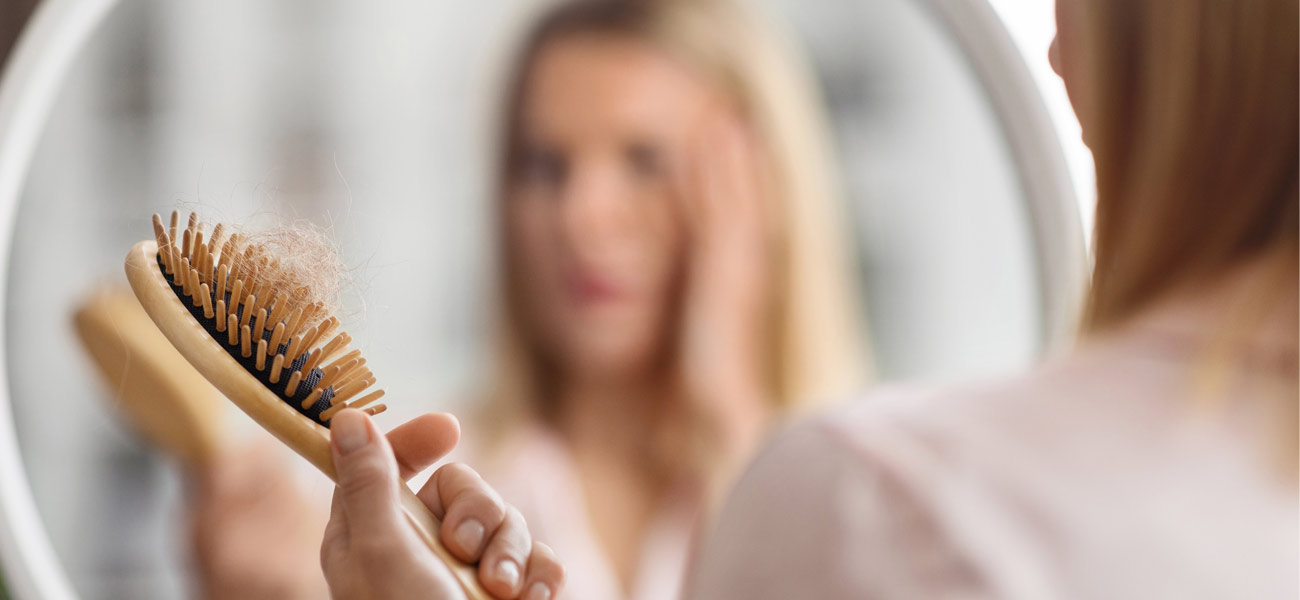
Beginning at reproductive age to menopause 50% of women will experience hair loss1. Hair loss is not just limited to aging women; it also happens in young women and regardless of age it creates a large burden on women. Most of the discussion in the media centers around male hair loss. This is just as much, if not more, of a female problem. Today we are going to discussed female hair loss and how to fix it!
When evaluating female hair loss, collecting a full history is necessary including other symptoms such as fatigue, abnormal menstrual cycles, current medications, and other medical problems. Next identifying the type of hair loss you are suffering from help guide causes and best treatment options. Has it been gradual or acute? Are you losing hair in patchy spots or is it more global? The pattern of hair loss is very important, male pattern vs central vs global. Let’s look at hair loss causes and types:
Female pattern hair loss: The most common cause of hair loss in women. Characterized by central-scalp thinning. This occurs more frequently with age2. This can be caused by hormonal imbalances such as menopause or elevated androgens.
Telogen effluvium: The most common cause of diffuse hair loss. This is triggered by stressors such as childbirth, severe illness, major surgery, medications (Fluoxetine, Lithium, Beta Blockers, Warfarin)3.
Traction alopecia: Common with hairstyles with tension (tight braids, extensions)
The pattern of hair loss can give you clues to the diagnosis and cause of hair loss. Male pattern hair loss could be from high testosterone levels or a sign of PCOS. Global hair loss is more likely to be Telogen effluvium.
Evaluation for female hair loss likely includes blood work that measures testosterone levels, iron levels, thyroid evaluation, and a hormonal assessment.
Treatment is individualized depending on testing results and other findings. For instance, thyroid disease related hair loss is typically reversable if the thyroid disease is treated and well controlled. Additionally, hair loss after childbirth, likely telogen effluvium, will resolve several months to a year after delivery without treatment. Still, some of these women will not experience full resolution.
Let’s discuss the many options that women have to stop hair shedding and improve hair growth!
Minoxidil, either topical or oral, is one of the best ways to improve hair growth. Topical Minoxidil has some of the strongest data supporting its use in female hair loss. It also has the lowest side effect profile. Oral Minoxidil is a great choice when Topical Minoxidil was not effective. Side effects with oral Minoxidil are low blood pressure, edema, and unwanted hair growth. Hypertrichosis (excess hair growth) occurs in approximately 15% of patients treated with oral Minoxidil2. This side effect will resolve on its own and there are options to prevent this side effect without switching medications. Minoxidil can also be enhanced or used in combination with other treatment options that will be discussed.
Androgens like testosterone have a large effect on female hair loss. Antiandrogenic medications such as Flutamide and Bicalutamide are some of the most effective medications at preventing hair loss2. These medications of course are most effective in women that have high testosterone levels but can also be effective for those women with normal testosterone levels. Side effects can include decreased libido, liver damage, and breast tenderness. Other antiandrogen medications for female hair loss include Finasteride and Spironolactone. These medications have fewer side effects and can be used in tandem with Minoxidil.
Shampoos with Ketoconazole can decrease inflammation and have antiandrogenic effects that can improve hair growth2. These shampoos are typically used along with Minoxidil or one of the antiandrogenic medications.
There are also other therapies that can be used if the above treatments fail or in combination with them. For instance, topical Minoxidil absorption can be improved with the help of microneedling. Or microinjections of Minoxidil or Bicalutamide can be used via Mesotherapy. Procedures such as Fractional laser and injections of Platelet-Rich Plasma (PRP) can trigger natural healing, increase blood close, and active hair stem cells2. PRP has more evidenced based support compared to Fractional Laser4. Although Fractional Laser does have studies with supportive evidence the quality of these studies is lower5. A combination of PRP and Fractional laser shows some of the best results6.
If medical treatment fails, hair transplant may be the next options. Hair transplant uses your own hair, typically from the back of your scalp, to be transplanted to areas with hair loss. There are two techniques to discuss Follicular Unit Transplant (FUT) vs Follicular Unit Extraction (FUE). Overall, both techniques work very well and have similar results7. Typically, FUT is preferred in women for the simple fact that you do not need to shave your head. FUT removes a donor strip from the back of your head, hair follicles from that strip are then individually removed and grafted to areas of hair loss. The incision in the back of the head is sutured closed and is well hidden by long hair styles. FUE avoids a linear scar in the back of the scalp by taking punch incisions on each hair follicle then grafting them. But shaving your scalp is necessary for FUE making this less desired by many women.
Natural supplements cannot be forgotten! These can be very effective for female hair loss. Nutrafol is a common brand name supplement for hair loss. This supplement was studied in women with subjective hair loss by the manufacture showing reduced hair shedding by 32%8. The supplement works through the anti-inflammatory, antioxidants, and antiandrogenic properties of Nutrafol. Side effects with this supplement are nausea, bloating, and diarrhea. Nutrafol can be expensive so consider buying the individual supplements that make up Nutrafol. Such as Saw Palmetto, this supplement has antiandrogenic properties and can be used alongside medications such as Minoxidil. Ashwagandha is also part of Nutrafols proprietary blend. Stress relief is an important treatment for hair loss, Ashwagandha has shown efficacy in stress and anxiety relief along with insomnia.
Hair loss can be treated! With a combination of treatments such as Minoxidil, antiandrogens, supplements, and adjuvant therapy you can decrease hair shedding and increase hair growth.
It’s important to get the appropriate work up and find the custom treatment plan that works best for you!
Second to None Health does not have any affiliations with the products listed in this article.
Work Cited:
1. Leavitt, Adam, et al. “Addressing the Root Causes of Female Hair Loss and Non‑Pharmaceutical Interventions.” Journal of Drugs in Dermatology, vol. 24, no. 7, 1 July 2025, pp. 659–662, doi:10.36849/JDD.8763. PubMed, PMID 40627570.
2. Olsen, Elise A. “Hair Loss in Women.” The New England Journal of Medicine, vol. 393, no. 15, Oct. 2025, pp. 1509–1520, doi:10.1056/NEJMcp2412146.
3. Dakkak, MaryAnn, Klive M. Forde, and Howard Lanney. “Hair Loss: Diagnosis and Treatment.” American Family Physician, vol. 110, no. 3, Sept. 2024, pp. 243–250.
4. Dubin, Danielle P., et al. “The Effect of Platelet‑Rich Plasma on Female Androgenetic Alopecia: A Randomized Controlled Trial.” Journal of the American Academy of Dermatology, vol. 83, no. 5, Nov. 2020, pp. 1294–1297, doi:10.1016/j.jaad.2020.06.1021. PubMed, PMID 32649961.
5. Gupta, Aditya K., Daniel Taylor, and Keyvan Nouri. “Lasers for Treatment of Androgenetic Alopecia: An In‑Depth Analysis.” Lasers in Medical Science, vol. 40, no. 1, 2025, p. 108, doi:10.1007/s10103‑025‑04365‑3. PubMed, PMID 39979533.
6. Haddad, Natalie, et al. “Evaluating the Efficacy of Platelet Rich Plasma and 1550 nm Fractional Laser in Combination and Alone for the Management of Androgenetic Alopecia.” Journal of Drugs in Dermatology, vol. 21, no. 11, Nov. 2022, pp. 1166–1169, doi:10.36849/JDD.6750. PubMed, PMID 36342732.
7. Gupta, Aditya K., Robin P. Love, and James A. Harris. “Old Friend or New Ally: A Comparison of Follicular Unit Transplantation and Follicular Unit Excision Methods in Hair Transplantation.” Dermatologic Surgery, vol. 46, no. 8, Aug. 2020, pp. 1078–1083, doi:10.1097/DSS.0000000000002373. PubMed, PMID 32141930.
8. Ablon, Glynis, and Sophia Kogan. “A Randomized, Double‑Blind, Placebo‑Controlled Study of a Nutraceutical Supplement for Promoting Hair Growth in Perimenopausal, Menopausal, and Postmenopausal Women With Thinning Hair.” Journal of Drugs in Dermatology, vol. 20, no. 1, Jan. 2021, pp. 55–61, doi:10.36849/JDD.5701. PubMed, PMID 33400421.